Amina Annabi: A Life Composed in Transit
By Tunez Magazine ·
Amina Annabi’s artistic world begins in a home where music is part of everyday life. Her early years in Carthage are shaped by women whose strength and independence leave a lasting impression on her. Music is more than a pastime. It becomes a language through which she learns to understand the world around her.
Her mother, a musician who also works as a festival programmer, introduces her to sounds from different cultures. Her grandmother sings fragments of malouf, connecting her to Tunisia’s musical heritage. At the same time, she listens to Oum Kalthoum, Tina Turner, and Italian popular music. These influences do not remain separate. They blend in her imagination, laying the foundations for the diverse musical style she will develop later in life.
At the age of twelve, Annabi moves to Paris. The change brings new experiences without erasing her connection to Tunisia. The city introduces her to different musical scenes and new ways of approaching sound. She studies several disciplines, including classical singing, jazz improvisation, and Egyptian traditional singing. Each style adds another dimension to her musical vocabulary. Her adolescence becomes a period of discovery, shaped by the people she meets and the sounds she encounters.
In the early 1980s, France is becoming increasingly interested in musical traditions from around the world. Annabi finds opportunities to explore this changing landscape through connections with people involved in Radio Nova. One important encounter is with Martin Meissonnier, a producer known for his work with African musicians. Their collaboration leads to her first single, “Shéhérazade,” in which she raps in Arabic over rhythms influenced by Grandmaster Flash.
The track brings attention to Annabi’s willingness to challenge musical boundaries. By bringing Arabic-language vocals into dialogue with hip-hop, she explores a sound that was still unusual in the French music scene. This early work marks an important step in her career and offers a glimpse of the artistic freedom that will continue to define her music.




Crossing Musical Borders
Throughout her career, Amina Annabi builds a network of collaborations that connects her to musical cultures across the world. In the mid-1980s, she records with hip-hop pioneer Afrika Bambaataa and Japanese musician Yasuaki Shimizu. These encounters allow her to explore new sounds while moving beyond established musical categories. Her growing popularity in Japan reflects the international reach of her work. She also performs on Haruomi Hosono’s album Omni Sight Seeing, further connecting her to Japan’s experimental electronic music scene.
Yalil and the Eurovision Stage
Her international profile grows with the release of Yalil, which reaches audiences in numerous countries. The album also gains recognition on the American Billboard charts for world music. Its success highlights Annabi’s ability to bring together Middle Eastern and North African influences with contemporary sounds. Rather than treating these traditions as separate worlds, she creates music that allows them to interact and evolve.
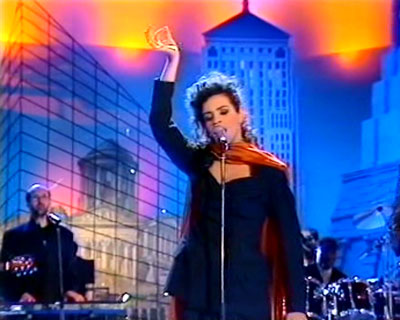
In 1991, Annabi represents France at the Eurovision Song Contest with “C’est le dernier qui a parlé qui a raison.” She finishes in a tie for first place on points with Sweden’s Carola, but the contest’s tie-breaking rules place her second. The performance nevertheless becomes a defining moment in her career. As a Tunisian-born artist representing France, she brings a complex cultural background to a competition often associated with national identity and representation.
From French Television to Amina
During the 1990s, Annabi continues to expand her presence in French popular culture. She performs alongside Bernard Lavilliers on the television programme Taratata and contributes to Malcolm McLaren’s Paris project. She also sings the theme song for the animated series Princesse Shéhérazade, lending her voice to a world shaped by legends and imagination.
Later in the decade, she releases an album bearing her family name, Amina. The record combines electronic textures with melodic traditions that have accompanied her since childhood. It also features reinterpretations of songs associated with Christophe and Billie Holiday. Rather than simply reproducing these works, Annabi approaches them through her own musical sensibility, creating a dialogue between her voice and the histories behind the songs.
Music as a Meeting Point
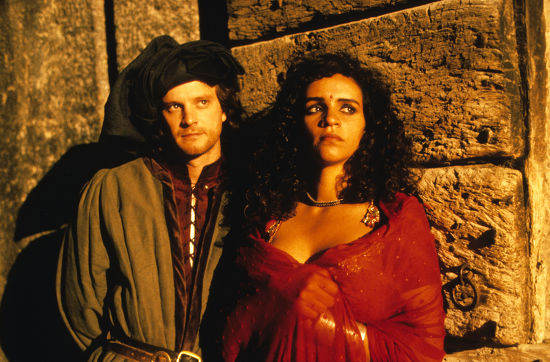
The beginning of the new century brings further artistic collaborations. Annabi takes part in an oratorio conceived by Goran Bregović that explores reconciliation among the religious communities of the Mediterranean. The project connects with themes that have long shaped her work, including cultural exchange and coexistence. She also contributes to the soundtrack of Bedwin Hacker, bringing her distinctive voice to the film’s sonic landscape.
Her artistic practice extends beyond recorded music. She performs in theatrical productions at venues including the Mogador in Paris and the Burgtheater in Vienna. She also develops a lasting collaboration with British group Asian Dub Foundation, joining a musical project known for combining political engagement with experimental sounds. Across these different settings, Annabi continues to explore new forms of expression while maintaining a connection to the cultural influences that have shaped her since childhood.
The events surrounding the Tunisian Revolution awaken a profound emotional response within her. Her composition Ya Nari Révolution emerges from a place of sincerity and historical consciousness. She performs the piece for the first time on the stage of the Carthage theater. The song blends Tunisian folk sonorities, oriental motifs, and the ceremonial rhythms of stambali, creating a form that honours the past while speaking to collective transformation. It becomes a musical tribute to the courage of a people and a reflection of her enduring connection to the land of her birth.
Her international presence continues through concerts and festival appearances across Scandinavia, Europe, North Africa, and the Middle East. Her collaborations with ensembles such as the Norrbotten Big Band and her work with the group Pajala Tatawin illustrate her commitment to musical exploration. These projects involve encounters between Northern European traditions and the Arab sound heritage that informs her vocal identity. They also reflect the increasing curiosity with which global audiences approach hybrid musical expressions.
Her more recent artistic period is marked by a turn inward. She records the album La lumière de mes choix, created in partnership with Léonard Lasry. She describes this work as a portrait, an intimate reflection on her life, her travels, and her emotional experiences. While the album presents a personal narrative, it also preserves the cosmopolitan imagination that guides her entire journey. She performs in festivals dedicated to electronic, Mediterranean, and world music traditions, demonstrating her ability to inhabit contexts that vary widely in aesthetic orientation.
Through her movement across continents and through her constant reconfiguration of musical languages, Amina Annabi becomes an emblem of the contemporary trans Mediterranean artist. Her voice carries within it the echoes of familial memory, the imprint of migration, and the influence of global artistic networks. Her trajectory reveals how cultural identity can be expressed not as a single lineage but as a living intersection of histories. The sound that emerges from her work resists confinement within a simple category. It contains the warmth of Tunisian tradition, the experimental impulse of Japanese electronic music, the political resonance of British fusion, and the lyrical intimacy of French chanson. Her creative life illustrates that music can operate as a vessel through which belonging is constantly renegotiated, reimagined, and renewed.