Archiving Retention by Dhia Dhibi
By Tunez Magazine ·
Dhia Dhibi is a Tunisian multidisciplinary artist, curator, and researcher whose practice explores the relationship between art and technology. Initially trained in three-dimensional digital art, he later pursued a research master’s degree in art theory and postgraduate studies in curatorial practices. His work examines how digital technologies shape perception, behavior, and social structures, with a particular focus on Tunisia and the broader SWANA region. This critical perspective informs his artistic practice, curatorial projects, and research.
Digital traces created during moments of political rupture are abundant, yet fragile. They circulate rapidly and accumulate unevenly, remaining vulnerable to deletion, account deactivation, content moderation, and the gradual disappearance of data as devices and formats become obsolete. These conditions raise fundamental questions about how societies preserve their histories and determine what remains accessible to future generations.
Archiving Retention, a mixed-media installation developed during the Emerging New Media Artists Programme at Diriyah Art Futures and exhibited as part of CONTINUUM ’25, explores these questions through the Tunisian Revolution of 2010–2011. The work translates digital traces of this period into a tactile archival environment made up of cabinets, drawers, and media carriers associated with older systems of storage and retrieval.
Rather than presenting analog storage as a stable alternative to digital systems, Dhibi uses this material arrangement to examine the uncertainties of historical preservation. The installation asks how memory is transferred beyond the individual, how digital records acquire the status of evidence, and how historical meaning is constructed when the primary sources of an event circulate through platforms that can also enable their disappearance.

Data, Traces, and the Politics of Digital Memory
A useful distinction can be made between data and traces. Data refers to information that can be copied and processed with little attention to the circumstances in which it was created. A trace, by contrast, retains marks of the encounter, risk, and mediation that produced it.
On social platforms, traces cannot be separated from the systems that shape them. These systems determine recording quality, compression, upload, visibility, and retrieval. Archiving Retention highlights this connection by treating pixelation, low-resolution images, and raw audio not as technical flaws to be corrected, but as records of specific historical conditions. These qualities reflect unequal access to devices and networks.
By focusing on documentation produced by ordinary participants, the installation challenges the assumption that historical authority must come from institutional media. It also raises a more difficult question: how do inequalities in recording events become inequalities in how those records are later recognized and valued?
Bernard Stiegler and the Externalization of Memory
The project explores these questions through Bernard Stiegler’s concept of tertiary retention. This refers to the externalization of memory and knowledge into technical supports that shape what can be remembered and how it can be recalled. Such externalized memory is never neutral. It determines how information is selected, organized, and accessed.
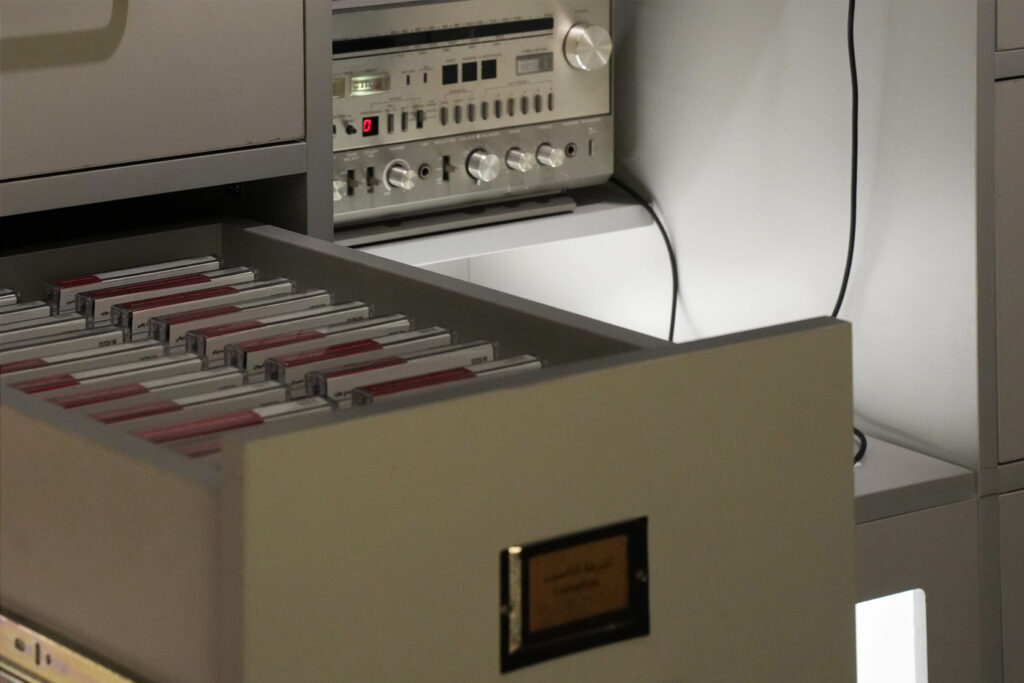
Platform architecture intensifies this process by linking the persistence of content to attention and ranking. A record’s continued visibility does not necessarily reflect its historical significance. Archiving Retention responds by relocating social media traces into a fictional museum-like archive that visitors can explore at their own pace. Through drawers, dossiers, and playback devices, the installation slows down the encounter with digital material. The rapid consumption associated with social media feeds gives way to the work of searching, opening, listening, and comparing.
Videos, Posts, and Sounds: Three Modes of Witnessing
The installation is organized into three sections: videos, posts, and sounds. Each explores how mediation shapes access to events and how archival categories influence later interpretations. This division is more than a classification of media types. It examines different ways of witnessing and recording history.
Video captures duration, movement, and proximity. Posts reveal coordination, rumor, and emotional expression. Sound records collective rhythm and the formation of crowds. By separating these forms while bringing them together within a single cabinet-based archive, the installation suggests that revolutions are not simply recorded. They are also organized, narrated, and experienced through sound. Each medium leaves behind a different kind of trace.
The Revolution as a Circular Archive
In the videos section, the first focal element is a three-dimensional printed pyramid made up of 29 concentric circular layers. Each layer represents one day of the uprising, and the circles increase in diameter to reflect the growing volume of documentation.
The structure draws on the dual meaning of the word revolution, which refers both to systemic change and to cyclical movement. It translates this tension into a physical form by placing a linear chronology within a circular structure.
The installation also gives the archive a tangible dimension through a process inspired by archaeological relief techniques. Each video thumbnail is converted into a height map, which is then used to create an embossed surface.
This transformation has important methodological implications. The image becomes more than a representation of an event; it also becomes a physical relief. Compression artifacts are incorporated into a visual language that recalls archaeological layers and the accumulation of material remains.
Visitors encounter the archive as volume, and that volume demands interpretation. A greater quantity of documentation does not automatically produce a clearer understanding of the past. Instead, it creates a responsibility to sort, contextualize, and evaluate the available evidence.
Mapping the Politics of Visibility
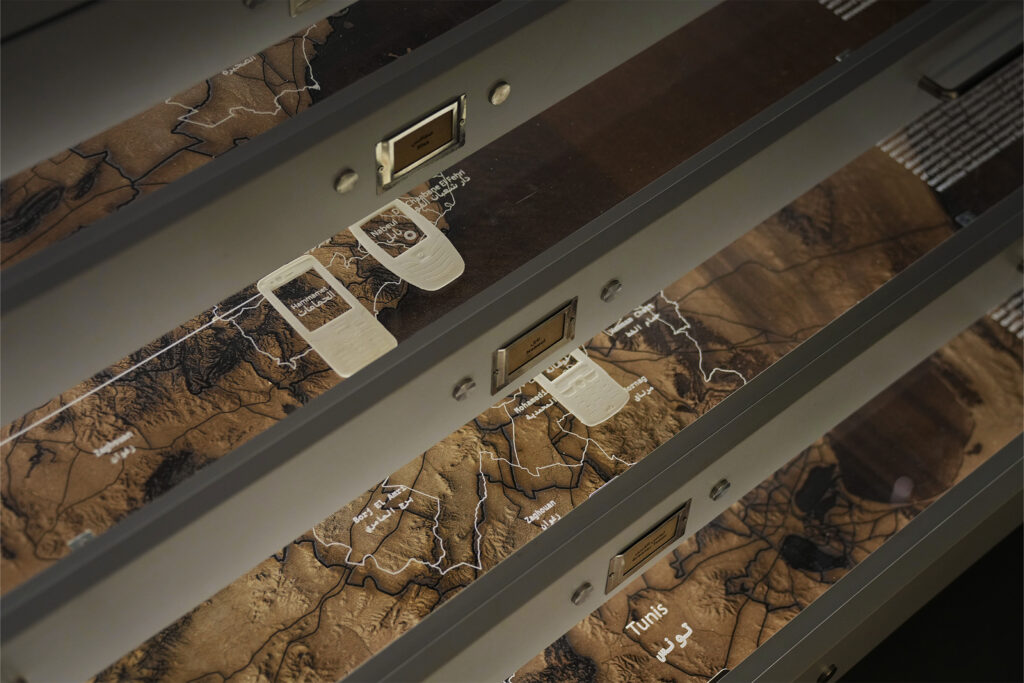
The second focal element in the videos section consists of regional maps that organize recordings across seven key areas: Sidi Bouzid, Kasserine, Tunis, Nabeul, Sfax, Bizerte, and Gabes. Through these maps, the installation highlights the politics of visibility. The quality and quantity of recordings reflect socioeconomic inequalities, since access to recording technology depends partly on financial means.
Layered topographic cutouts are combined with phone models identified through metadata analysis. Textual annotations also trace social class and the routes through which recordings circulated. Together, these elements reveal the conditions under which evidence becomes available. This matters because historical research can mistake the abundance of records for historical importance. In reality, that abundance may reflect unequal access to technology rather than the significance of an event.
Scrolling Through the Digital Archive
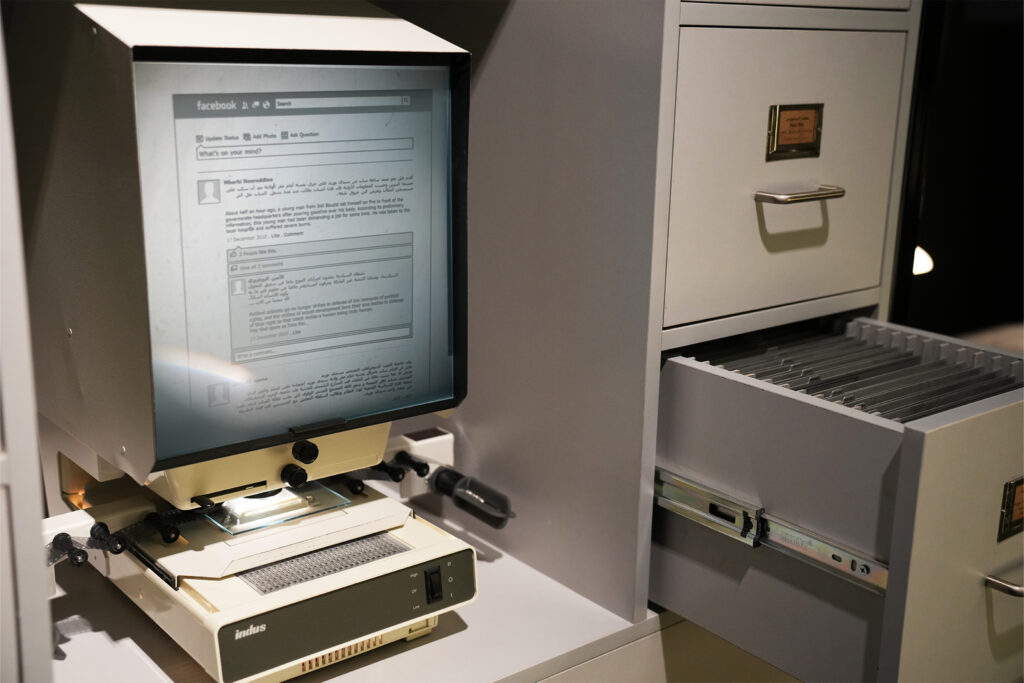
The posts section explores another form of archival instability: the role of interfaces in shaping how information is understood. Facebook status updates that helped organize decentralized protests are preserved on microfilm. Visitors must manually scroll through the reel using a reader.
This choice introduces a deliberate change of pace. It draws attention to the physical habit of scrolling and shows that a platform feed is more than a neutral container. It also shapes how people perceive and consume information. Reading microfilm requires effort, patience, and orientation. It restores a sense of scarcity and duration to a digital environment usually associated with speed and abundance. The posts are no longer replaceable items in an endless stream. Instead, they become traces that demand time and attention before they can form a meaningful historical account.
Images, Interfaces, and the Loss of Context
Another element in the posts section consists of archival files containing analog photographs developed from digital images. Detached from their original context, these photographs appear in low resolution, echoing the fragmented nature of personal recollection. Their contextual relationships become visible only when they are placed within a simulated Facebook interface.
This movement between isolated images and framed images highlights a crucial point: context is not an addition to content. It helps determine what a record can legitimately tell us. Images circulating alone can be misattributed, separated from their original timeline, or reused to support different arguments. By recreating the interface as a recoverable frame, the installation suggests that archiving social media requires more than preserving individual files. It also means retaining the conditions in which those files were shared, received, and understood.
Sound as Evidence of Collective Memory
The sounds section extends these questions into the sonic domain. It begins with a vinyl record containing an amateur song that documents the burning of a police station in Menzel Bouzaiane. The recording is presented in a listening environment that treats sound as both historical evidence and an active part of collective action.
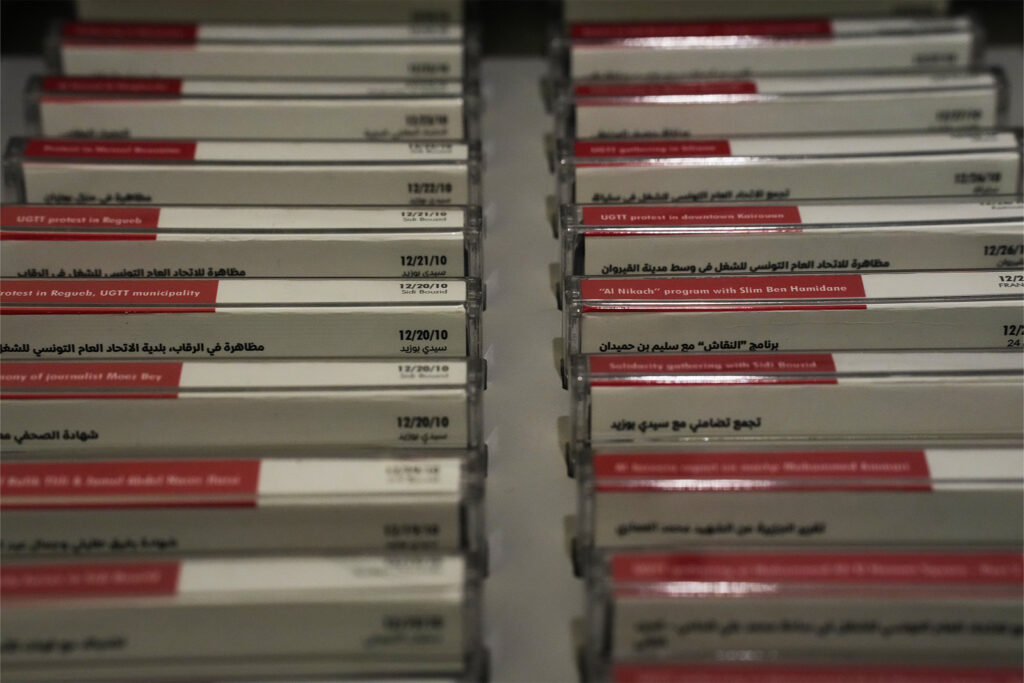
The use of vinyl is not simply a gesture toward durability. It also reveals how a format can shape perceptions of archival value. Vinyl encourages deliberate listening and suggests an act of preservation, unlike compressed audio files that circulate rapidly online. Beside the record, cassette tapes preserve protest slogans and anthems. Organized by duration, region, and date, they form a layered sonic archive.
Together, these recordings acknowledge the fleeting nature of sound while emphasizing the historical significance of chants, rhythms, and repetition. Deterioration and background noise become part of the record. They do not serve as nostalgic decoration but reveal the material vulnerability of memory.
The Archive as an Archaeological Problem
Across these elements, Archiving Retention approaches the archive as an archaeological problem. The project draws on the work of Tunisian researchers and historians who collected digital content years after the events and assembled an archive in 2019. Their research encountered deactivated accounts, deleted or flagged posts, and abandoned phones.
The archaeological analogy is central to the work. Archaeologists reconstruct past societies from incomplete remains, treating absence as a possible sign of loss, destruction, or selective survival. Digital platforms create similar challenges. Content can disappear through moderation, policy changes, user fear, or technological decay. By presenting the collected media in a museum-like system of cabinets, the installation makes retrieval uncertain and laborious. It reminds viewers that historical knowledge built from digital traces must always be reconstructed within specific limitations.
Archiving as a Political Act
A central implication of the work is that archiving is a political act. Every archive involves decisions about what should be preserved, how it should be classified, which metadata should accompany it, and who should be able to access it. Platform governance often makes these decisions implicitly, following priorities that may conflict with historical preservation.
Archiving Retention responds by prioritizing grassroots material over institutional sources. It also shows how the architecture of social media can be translated into a physical archive, changing both the pace of consumption and the viewer’s relationship with the material. The installation does not claim to establish authenticity or completeness. Nor does it conceal the gaps in the historical record. Instead, it makes those gaps central to interpretation and invites viewers to understand the archive as a contested space rather than a neutral repository.
The Limits of Material Preservation
However, materializing digital traces also raises a difficult question. Cabinets, dossiers, microfilm, vinyl, and cassette tapes can lend records the authority of physical artifacts. Their familiar archival forms may suggest stability, even when the underlying content remains incomplete, disputed, or ethically sensitive.
The exhibition itself also involves curatorial selection. Moving material from online platforms into a gallery inevitably shapes its presentation and can shift the balance of authorship or narrative emphasis. These concerns become particularly important when archives contain identifiable individuals or document politically charged events.
The installation addresses these risks not by claiming neutrality, but by exposing the processes that make preservation uncertain. Obsolescence, deletion, and unequal access to technology remain visible throughout the work. The museum-like setting therefore becomes a subject of inquiry in its own right, rather than a guarantee of historical authority.
Reconstructing Context from Digital Traces
A second concern is the loss of context. Extracting posts and other media from social platforms can separate them from the comments, shares, and social interactions that once shaped their meaning. Even a simulated interface cannot fully reconstruct these relationships.
The installation responds by making the problem of context visible. Through manual browsing and comparison, visitors must reconstruct connections between different traces. Historical interpretation consequently becomes more than the recovery of information. It requires a careful examination of the relationships among surviving records.
The effort involved in scrolling through microfilm, searching drawers, and playing recordings reinforces this idea. Understanding the past becomes an act of responsibility rather than passive consumption.
The Politics of Remembering the Tunisian Revolution
Ultimately, Archiving Retention offers a critical account of political memory in an age of constant content creation and accelerated circulation. Digital evidence is neither inherently durable nor automatically meaningful. Its survival and interpretation depend on infrastructure, social inequality, and platform governance.
By translating traces of the Tunisian Revolution of 2010–2011 into a hybrid archive built around physical cabinets and media carriers, the installation does more than preserve the past. It changes the conditions under which that past can be encountered, evaluated, and debated.
The work’s central argument is that collective memory depends on more than storing files. It also requires forms of access that account for technological decay, the loss of context, and the unequal circumstances in which historical evidence is produced.