

Jaou Tunis 2026: Contemporary Art, Music and Culture in Tunis
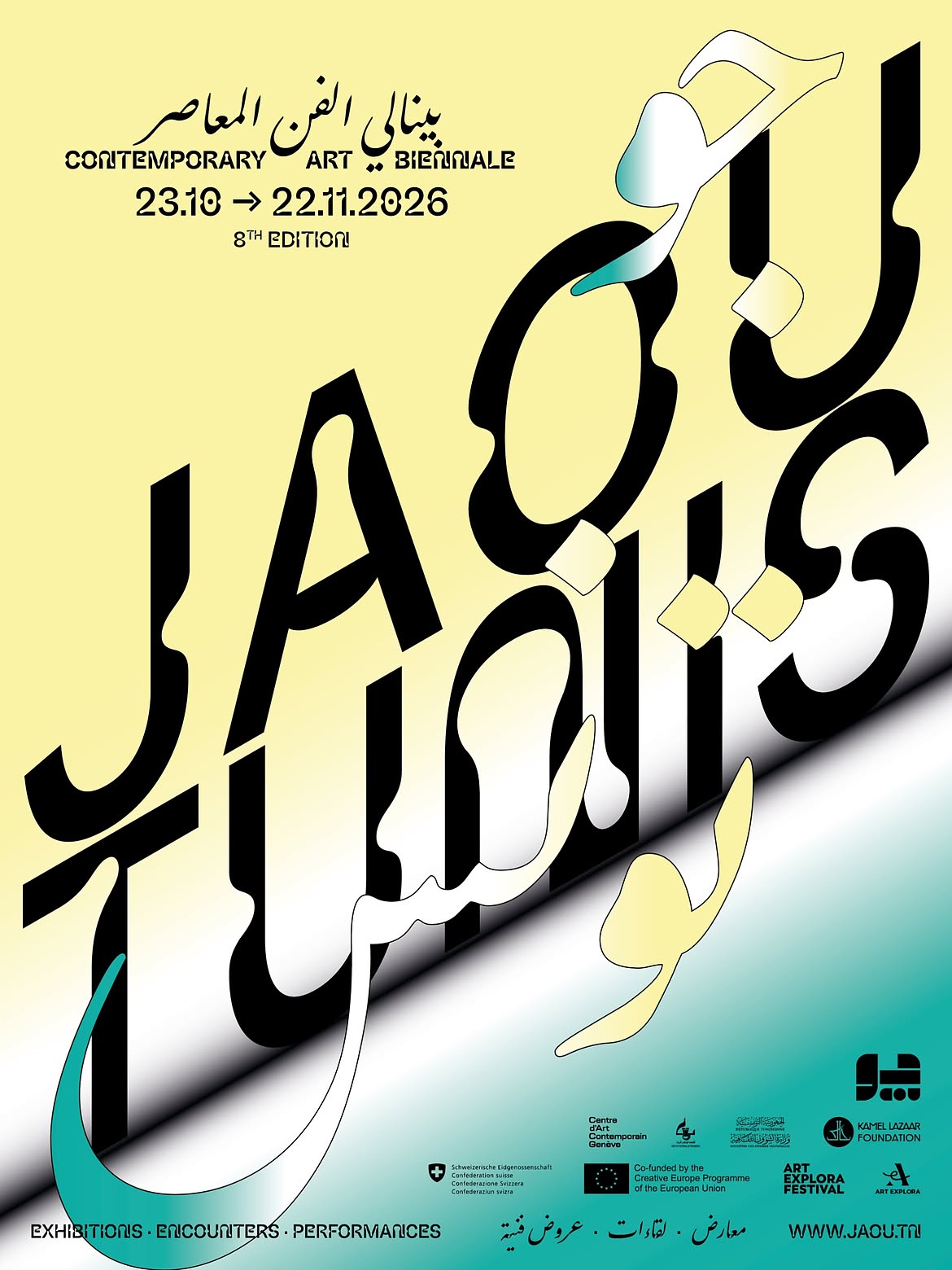
From October 23 to November 22, 2026, Tunis will host the eighth edition of Jaou Tunis, bringing together contemporary art, moving image, music, dance, performance and public conversations across several cultural spaces in the city.
Organised by the Kamel Lazaar Foundation in partnership with the Centre d’Art Contemporain Genève and the Art Explora Foundation, Jaou 2026 brings an ambitious international programme to Tunisia while placing Tunis itself at the centre of a wider conversation about contemporary culture, artistic production and the ways different histories and regions can meet.
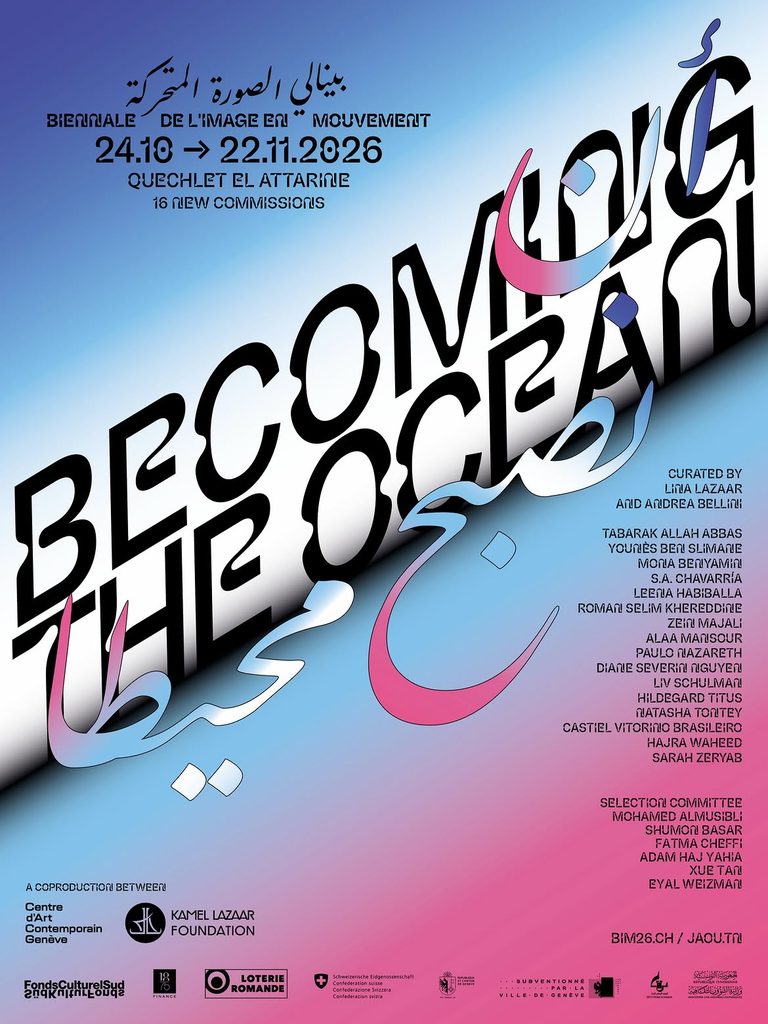
One of the most important moments of this edition will be the presentation of “Becoming the Ocean”, the major exhibition of the 2026 Biennale de l’Image en Mouvement, at Caserne El Attarine in the Medina of Tunis from October 24 to November 22.
For the first time in its history, the Biennale de l’Image en Mouvement will leave Switzerland and be presented on the African continent. The exhibition is co produced by the Centre d’Art Contemporain Genève and the Kamel Lazaar Foundation and is curated by Lina Lazaar and Andrea Bellini.
The exhibition brings together sixteen newly commissioned artists from Africa, the Arab world, Asia, Latin America and their diasporas. Their practices explore questions of memory, migration, colonial histories, ecological crisis, technology, political struggle and changing relationships between people and their environments.
The artists participating in “Becoming the Ocean” are Tabarak Allah Abbas, Younès Ben Slimane, Mona Benyamin, S.A. Chavarría, Leena Habiballa, Roman Selim Khereddine, Zein Majali, Alaa Mansour, Paulo Nazareth, Liv Schulman, Diane Severin Nguyen, Hildegard Titus, Natasha Tontey, Castiel Vitorino, Hajra Waheed and Sarah Zeryab.
The exhibition takes place inside Caserne El Attarine, a historic nineteenth century military building in the heart of the Medina. The location adds another dimension to the exhibition, bringing contemporary moving image into a building shaped by the military and political history of Tunis.
The title “Becoming the Ocean” comes from an image associated with Khalil Gibran, in which a river understands its transformation into the ocean not as disappearance, but as another form of existence. The idea becomes a starting point for thinking about transformation, connection and survival.
The exhibition asks what happens when the boundaries separating people, territories and identities become less fixed. It looks at how histories and experiences that may appear distant are connected through larger political, ecological and social realities.
For Tunis, the arrival of the Biennale de l’Image en Mouvement is significant beyond the exhibition itself. It places the city within a wider international conversation around moving image and contemporary artistic production, while also creating an opportunity for local artists, cultural workers and audiences to engage with artists and institutions from different parts of the world.
Jaou 2026 is not limited to “Becoming the Ocean”.
At B7L9 Art Centre, “Undertow / Contre Courant”, curated by Amanda Abi Khalil and Danielle Makhoul, brings together another large group of artists, including Lorenzo Pezzani, Charles Heller, Younès Ben Slimane, Majd Abdel Hamid, Mounira Al Solh, Bouchra Khalili, Akram Zaatari and others.
The exhibition adds another perspective to the wider programme, bringing questions of borders, migration, political violence, memory and contemporary realities into the conversation.
B7L9’s presence is also important geographically. Located in Bhar Lazreg, the contemporary art centre has developed a programme that connects contemporary art with a wider audience outside the traditional cultural centre of Tunis. Since opening in 2019, B7L9 has hosted exhibitions, workshops, discussions, performances and concerts, becoming an important part of Tunisia’s contemporary cultural landscape.
Music and performance occupy an equally important place in Jaou 2026.
The programme brings together artists working across different musical and performance traditions, including Yasmine Hamdan and Soudeni, SHABAKA, Julmud, Toumba, Big Murk, Liliane Chlela, Sara Dziri and Nadah El Shazly.
These performances are accompanied by a strong dance programme, with Samar Haddad King and Yaa Samar! Dance Theatre presenting several works, including “Shabaab”, “Beiti Jerusalem” and “Losing It”, created with Samaa Wakim.
Other performances include works by Charles Brecard, Cyrine Kalai and Selim Ben Safia, showing the diversity of contemporary dance and performance practices represented in this year’s programme.
Jaou also extends into photography, film and historical documentation.
At the Institut Français de Tunis, photographer Michel Eisenlohr presents “Images de Syrie, Palmyre, Alep, Damas”, while composer Khalil EPI presents “Tuqus” at the Cité de la Culture.
The programme creates a movement between different artistic forms rather than treating them as separate categories. Contemporary art can meet music, photography can meet performance, moving image can meet architecture, and historical spaces can become places for new artistic experiences.
This is particularly relevant in Tunis, a city whose cultural history has always been shaped by movement.
Situated in North Africa and facing the Mediterranean, Tunis has long been a place where different cultures, languages, religions and artistic traditions have crossed paths. Jaou’s international programme builds on this history without reducing the city to a simple meeting point between Europe, Africa and the Arab world.
The Mediterranean itself occupies an important place in the wider programme through the participation of Art Explora. Its Mediterranean festival arrives in Tunis as part of a journey across the region, looking at the sea not only as a geographical boundary but also as a space of exchange, movement and shared memories.
At the same time, the Mediterranean remains a deeply unequal space, shaped by migration, borders and political tensions. This contradiction is part of the reality that contemporary cultural institutions have to confront.
Jaou 2026 does not attempt to present Tunis as a neutral meeting point. Instead, it places the city inside these wider conversations.
This is also what makes the collaboration with the Centre d’Art Contemporain Genève particularly interesting. The presentation of the Biennale de l’Image en Mouvement in Tunis is not simply about bringing an established European institution to Tunisia. The 2026 edition involves new commissions, local production and collaboration with cultural workers and artists from different regions.
The sixteen artists have been invited to create new works, giving the Tunis exhibition a role in the production of contemporary art rather than simply presenting finished works imported from elsewhere.
This distinction matters.
Tunis is not simply hosting the exhibition.
It is becoming part of its story.
After its presentation in Tunis, the exhibition will continue its journey, connecting the work produced and presented here to other international contexts. This creates a different kind of cultural exchange, one in which Tunisia is not simply receiving international programming but participating in its production and circulation.
That may ultimately be one of the most important aspects of Jaou 2026.
The Biennale arrives at a moment when contemporary art is increasingly concerned with questions of movement, borders, identity, memory and ecological change. These are not abstract subjects for North Africa. They are part of the region’s everyday reality.
Migration crosses the Mediterranean. Climate change is transforming landscapes and communities. Political borders continue to determine who can move and who cannot. Digital technology is changing how images are produced and circulated. Historical memory remains contested.
Contemporary art cannot remain outside these questions.
Jaou 2026 brings many of them into the same cultural space.
But perhaps the most interesting aspect of the Biennale is that it does not reduce contemporary culture to one artistic language. It creates a space where different practices can exist alongside one another.
An exhibition in the Medina.
A performance at Le Rio.
A concert at the Ancienne Bourse du Travail.
An exhibition at B7L9.
A photographic project at the Institut Français.
A performance at the Cité de la Culture.
Different audiences, different artistic practices and different parts of Tunis become connected through the programme.
For several weeks, the city itself becomes the framework.
This makes Jaou more than a conventional contemporary art exhibition. It becomes a way of moving through Tunis and discovering how different cultural spaces can communicate with one another.
The success of such a project will ultimately depend not only on the international names involved, but on what happens when the programme meets its Tunisian audience.
What conversations will emerge?
What new collaborations might begin?
How will local artists and cultural workers respond?
And what will remain after the Biennale closes on November 22?
These questions are perhaps more important than the idea of a spectacular cultural event.
Jaou 2026 has the potential to create something that lasts beyond its calendar. International collaborations can become local relationships. New artistic commissions can continue travelling. Audiences can discover new forms of contemporary art. Tunisian artists and cultural workers can enter new networks.
The Biennale therefore offers Tunis more than a month of exhibitions and performances.
It offers a moment to look at the city through contemporary art and, at the same time, to allow the world to look at Tunis from another perspective.
From October 23 to November 22, Jaou Tunis 2026 will bring together artists, musicians, performers, curators and audiences across the city.
The programme is international, but its real significance will be local.
Because ultimately, the question is not simply what Jaou brings to Tunis.
It is what can happen when all these ideas, artists and audiences meet here.
Post a Comment