Ghali celebrates 10 years of “Ninna Nanna”
By Tunez Magazine ·
Today October 28, 2026, Ghali celebrates the tenth anniversary of “Ninna Nanna”, the single that helped transform his career and marked a turning point for Italian urban music. Produced by Charlie Charles and released through Sto Records, the track reached number one on Italy’s FIMI singles chart, achieved four-times Platinum certification and became one of the defining releases of a new generation of Italian rap.
Ten years later, its influence extends beyond its commercial success. With 68 million Spotify streams and 136 million YouTube views reported for the anniversary, “Ninna Nanna” remains a landmark in Ghali’s journey from Milan’s outskirts to the centre of Italian popular culture.
From Baggio to the Italian music scene
Born in Milan in 1993 to Tunisian parents, Ghali Amdouni grew up in Baggio, a neighbourhood on the western outskirts of the city. His background would become an important part of his artistic identity, shaping a musical language that brings together Italian street culture, multilingual expression and influences from different cultural worlds.
He began his career under the names Fobia and Ghali Foh before adopting the name Ghali. In 2011, he formed Troupe d’Elite with fellow musicians, gaining early experience in the Italian rap scene. He later developed his solo career through online releases and videos that helped him build an audience before the breakthrough of 2016.
By the time “Ninna Nanna” arrived, Ghali was already developing a distinctive identity. Rather than simply following established conventions, he combined trap production with melodic vocals, personal storytelling and a visual aesthetic that stood apart from much of the mainstream Italian rap landscape.
The record-breaking success of “Ninna Nanna”
Produced by Charlie Charles, one of the central producers behind the rise of Italian trap, “Ninna Nanna” became a major commercial milestone. The track entered the FIMI Top Singles chart at number one, demonstrating the growing power of streaming in a music industry still adapting to new listening habits.
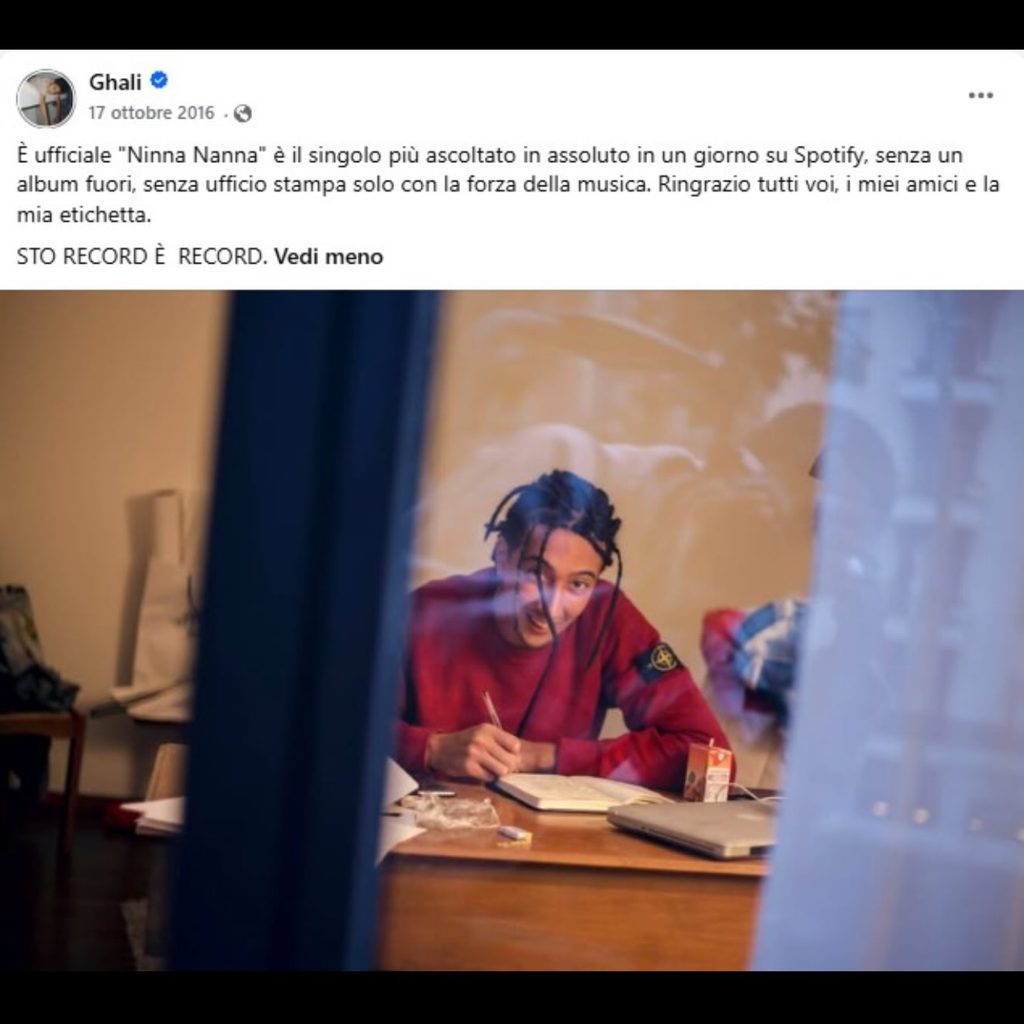
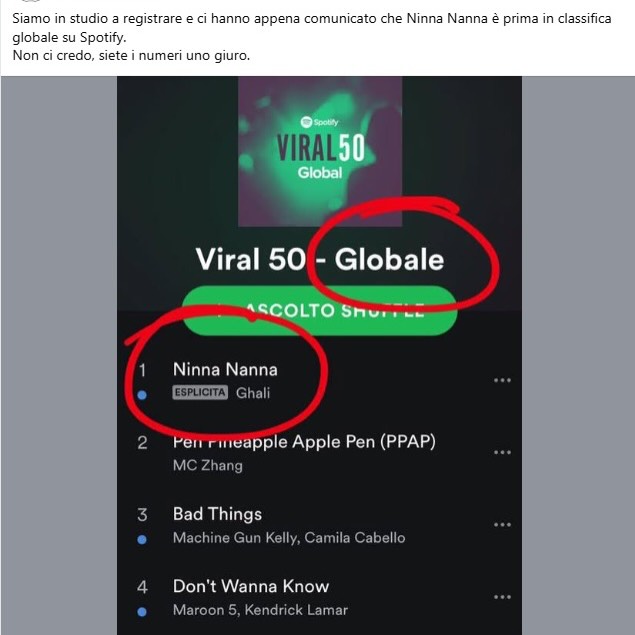
Its early performance was particularly significant. The song surpassed 200,000 Spotify streams during its first 24 hours and reached the platform’s global Viral 50 chart. It earned Gold certification within two weeks, followed by Platinum awards and eventually four-times Platinum certification in Italy.
The release also represented an important moment for Sto Records, Ghali’s independent label. By launching the single through his own imprint, the rapper established a stronger degree of independence over his music and career. The success of “Ninna Nanna” helped lay the groundwork for his debut studio album, Album, released in May 2017. That record further consolidated his position through songs including “Pizza Kebab”, “Happy Days” and “Habibi”.


A personal song with a wider cultural impact
Beyond the numbers, “Ninna Nanna” connected with listeners through its personal dimension. The song draws on autobiographical memories, family relationships and the desire to overcome difficult circumstances. Its emotional core includes a tribute to Ghali’s mother, giving the track a sense of intimacy that distinguishes it from a conventional celebration of success.
Its wider significance also lies in the moment it represents. In the mid-2010s, streaming was changing how Italian audiences discovered music and how artists reached the charts. “Ninna Nanna” became one of the clearest examples of this transition, helping demonstrate that a new generation of rappers could reach the top without relying exclusively on traditional promotional models.
For Ghali, the breakthrough carried an additional cultural dimension. As an Italian artist of Tunisian origin, he helped broaden the representation of contemporary Italian identity within mainstream music. His success formed part of a wider shift in which artists with diverse backgrounds increasingly shaped the country’s cultural conversation.
“Da una stalla a una stella”: Ghali looks back
To mark the anniversary, Ghali shared a personal reflection on ten years of change, acknowledging the birth of Sto Records, the evolution of Italian music and the transformations in his own life and that of his fans.
Opening with “Da una stalla a una stella” (“From a stable to a star”), his message looks back on a career built through choices that have not always followed the industry’s expectations. He reflects on his reputation as an unpredictable artist, his refusal to follow established formulas and the frustration of sometimes feeling overlooked in discussions about the evolution of Italian rap.
Above all, however, he directs his gratitude towards the people who have supported him since the beginning. He recognises the fans who stayed, those who drifted away and those who eventually returned, describing their patience and trust as the foundation of his journey.
His closing words leave the next chapter deliberately open: “Da dove veniamo lo sappiamo bene, ma dove vi sto per portare… solo Dio lo sa.”
Ten years after its release, “Ninna Nanna” stands as more than a successful single. It captures a moment when Italian trap moved closer to the mainstream, when streaming began reshaping the industry’s rules and when Ghali established himself as one of the voices defining a new musical generation. Its anniversary is both a celebration of that breakthrough and a reminder that his story has never been limited to a single chart position.