Ten Years of As I Open My Eyes
By Tunez Magazine ·
Hakka Distribution and the film’s national release
The national tour and distribution of Where the Wind Comes From have been led by Hakka Distribution, an independent distributor operating within Tunisia’s film industry. Beyond its initial theatrical release, the company’s work on the film extends its reach to wider audiences through a broader distribution and screening strategy.
Bringing Tunisian cinema to wider audiences
In Tunisia, films can reach audiences through several channels. Alongside cinemas, festivals and cultural venues provide additional spaces for screenings and audience engagement. As a result, these platforms can help bring films to viewers across different regions and cultural settings.
Amel Guellaty’s film beyond the festival circuit
Through Hakka Distribution’s involvement, Where the Wind Comes From has the opportunity to reach audiences beyond the festival circuit. Moreover, its distribution places the film within Tunisia’s wider cinematic conversation, giving viewers further opportunities to discover Amel Guellaty’s perspective on youth, friendship and the search for a different future.
Farah and the search for self-expression
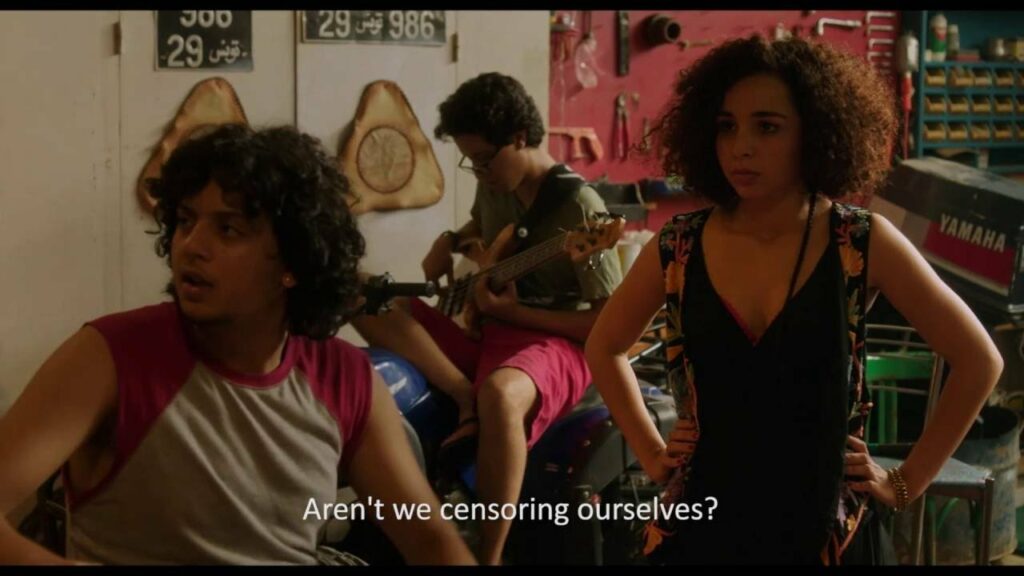
The character of Farah, played by Baya Medhaffar in her first major role, anchors the film in the immediacy of youth. At eighteen, Farah is neither an emblem nor a symbol. Instead, she is impulsive, inconsistent and often reckless. Her involvement in an underground rock band is not presented as heroic resistance. Rather, it reflects an instinctive search for space and self-expression. Music becomes her means of communication when other forms of expression have failed her. Although the lyrics she sings are explicitly political, the film focuses on the act of singing itself, emphasizing breath, voice and presence rather than rhetoric. Ten years later, this approach feels particularly deliberate. Through Farah’s performances, Leyla Bouzid presents music as a lived experience rather than a political message.
Surveillance and the tensions within family life
One of the film’s most enduring strengths lies in its portrayal of surveillance as something diffuse and internalized. The threat does not exist solely in police stations or interrogation rooms. Instead, it permeates conversations, glances and the caution exercised by parents and friends. Farah’s mother, Hayet, portrayed by Ghalia Benali, embodies this complexity with remarkable precision. She is neither simply an antagonist nor an uncomplicated protector. Her fear is inherited, shaped by years of adapting to an authoritarian environment.
Consequently, the conflict between mother and daughter becomes more than a generational disagreement. It reflects a clash between different strategies for survival. While Farah seeks freedom through music and self-expression, Hayet attempts to protect her daughter from the dangers she knows too well. Over the past decade, this relationship has acquired additional interpretive depth, particularly as the realities that followed the Tunisian Revolution complicated earlier hopes for change.
A visual portrait of everyday Tunisia
Visually, the film avoids stylization that might distance it from its setting. Tunis appears without postcard framing or exotic emphasis. Instead, streets, apartments, cafés and rehearsal spaces function as everyday environments shaped by use rather than symbolism. The cinematography remains close to the characters, frequently employing handheld camerawork that makes the camera feel embedded in their world rather than positioned above it.
As a result, the film maintains a sense of immediacy that extends beyond its original political context. Rather than simply representing Tunisia in 2010, it captures what it felt like to inhabit that period. Ordinary gestures, familiar surroundings and intimate encounters become essential to the film’s historical significance. Through this approach, Bouzid preserves the atmosphere of a particular moment without reducing it to a retrospective account of political events.
A film that transcends its historical moment
When As I Open My Eyes premiered at Venice Days in 2015, critics noted its restraint and precision, particularly its refusal to dramatize repression through overt spectacle. Over the following decade, these qualities have remained central to its impact. The film does not present itself as a revolutionary artifact, even though its story is inseparable from the historical moment that followed.
Instead, Bouzid documents the emotional and psychological conditions that made political rupture imaginable. She does so without claiming to explain everything that came afterward. The distinction is important: the film captures a particular atmosphere of uncertainty, frustration and desire without turning its characters into instruments of historical interpretation. In this respect, its restraint allows the story to remain open to new readings as Tunisia’s recent history continues to be reassessed.
Between pre-revolutionary and post-revolutionary cinema
Within Tunisian cinema, As I Open My Eyes occupies a distinctive position. It belongs neither entirely to the pre-revolutionary era it depicts nor neatly to the post-revolutionary wave of filmmaking that followed. Its production and release place it at a historical threshold, shaped by memory, proximity and a careful refusal of hindsight.
This position helps explain the film’s continued circulation internationally, including in academic contexts, retrospectives and discussions about youth, music and political subjectivity. Furthermore, its themes extend beyond the specific circumstances of Tunisia. Questions about artistic freedom, generational conflict and the personal consequences of political control remain relevant to audiences in different cultural contexts. Rather than resolving these questions, the film invites viewers to consider their complexity.
Ten years later: the significance of a moment preserved
Ten years after its release, As I Open My Eyes can be understood as a film about thresholds: between adolescence and adulthood, expression and consequence, silence and speech. Its lasting importance lies not in prediction or definitive representation, but in its attention to the details that larger historical narratives often overlook.
By focusing on gestures, relationships and moments of musical expression, Leyla Bouzid preserves a fragile period that might otherwise disappear beneath the weight of subsequent events. The film does not claim to speak for an entire generation or provide a definitive account of Tunisia’s political transformation. Instead, it offers an intimate portrait of young people negotiating the limits imposed on their lives. That sustained attention to their experiences is what continues to give the film its quiet authority a decade later.