More Than a Decade Missing: The Silence Around Chourabi and Ktari
By Tunez Magazine ·
Tunisia After the Revolution
In September 2014, Tunisia was still experiencing the profound changes brought by the 2011 revolution. The press was striving to establish itself as a fourth estate, capable of holding power accountable and seeking the truth in a region marked by growing instability.
Among the journalists making their mark were Sofiane Chourabi, known for his bold writing and investigative reporting, and Nadhir Ktari, a young photographer who had accompanied him on several assignments. Together, they travelled to Libya on a journalistic mission.
Their destination was a country enduring one of the most violent periods in its modern history. Armed militias were expanding their influence, while the rise of the Islamic State in parts of Libya dominated regional and international headlines. Chourabi and Ktari crossed the border to document events on the ground, unaware that their journey would lead to a disappearance that remains unresolved.
Two Disappearances in Five Days
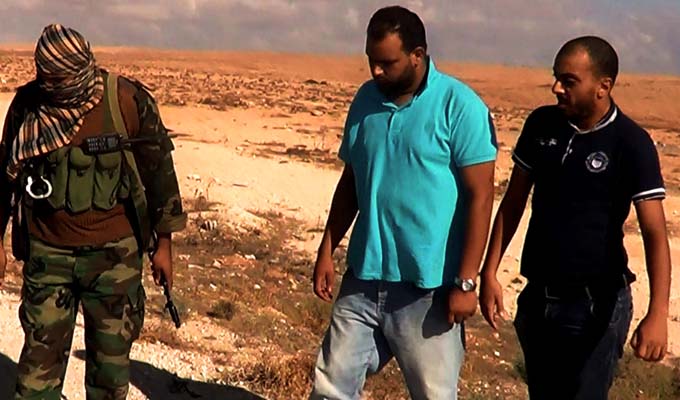
On September 3, 2014, while travelling towards the city of Brega, Chourabi and Ktari were intercepted by an armed group and taken to an unknown location. Their detention sparked concern among colleagues and within Tunisia’s journalistic community.
After hours of uncertainty, reports emerged that the two men had been released. What initially appeared to be another dangerous encounter in a conflict zone soon took a more troubling turn.
Just five days later, on September 8, they disappeared again, reportedly near Ajdabiya. This time, there was no confirmed release, no reliable account of their whereabouts, and no clear explanation of what had happened. Their disappearance marked the beginning of a painful ordeal for their families and a lasting question for Tunisia.
Conflicting Reports and Unanswered Questions
In the days following their disappearance, contradictory reports began to circulate. Some claimed that Chourabi and Ktari were being held by a local armed group and would soon be released. Others suggested that they had fallen into the hands of the Islamic State, which was expanding its presence in eastern Libya.
Media outlets and social media accounts circulated conflicting claims, ranging from reports that the journalists were safe to allegations that they had been executed. Yet reliable, independently verifiable evidence remained elusive.
In January 2015, a statement attributed to the Islamic State’s Libyan branch claimed that the two journalists had been killed. However, the announcement was not accompanied by publicly verified photographic or video evidence establishing their fate.
The absence of such evidence left crucial questions unanswered. Although the Islamic State had used hostage executions as propaganda, the lack of verifiable proof in this case could neither confirm nor disprove the claim. The statement deepened the uncertainty surrounding Chourabi and Ktari rather than providing a definitive account of what had happened to them.
Conflicting Claims and the Search for Evidence
In April 2015, Libyan officials announced that detained individuals had confessed to killing Sofiane Chourabi and Nadhir Ktari and burying their bodies in a remote area of eastern Libya. International media widely reported the claims. However, without recovered bodies, publicly available forensic findings, or independently verified evidence, the journalists’ fate remained unconfirmed.
The announcement raised further questions rather than bringing closure. Could investigators establish what had happened, and were the authorities able to verify the alleged confessions? Without conclusive evidence, the case remained unresolved, leaving the families caught between official statements and the absence of answers.
Families Refusing to Give Up
In Tunisia, the news deepened the anguish of the journalists’ families. Their search became a long struggle against uncertainty, sustained by the hope that some trace of Sofiane or Nadhir might still be found.
Nadhir Ktari’s mother emerged as a determined voice in the campaign to discover her son’s fate. She travelled between Tunisia and Libya, sought meetings with officials and intermediaries, and pursued every lead available to her. The search took place in a dangerous environment, where armed groups controlled different territories and movement between areas could carry considerable risks.
Each new account offered a possibility, only for that possibility to fade when evidence failed to emerge. Yet the search continued. For the families, the absence of reliable information meant that grief could never fully become mourning. Without confirmation of what had happened, waiting itself became a lasting burden.
A Campaign for Accountability
The National Syndicate of Tunisian Journalists worked to keep the case in the public eye through demonstrations, official statements, and appeals to international institutions. It called for greater efforts from the Tunisian authorities to establish the journalists’ fate and secure accountability.
International press freedom organizations, including Reporters Without Borders and the Committee to Protect Journalists, also raised concerns and called for answers. Their interventions highlighted the dangers facing journalists in conflict zones and the importance of investigating attacks against media professionals.
The case became more than a question of the whereabouts of two individuals. It also raised broader concerns about the protection of journalists, the ability of states to investigate crimes committed across borders, and the consequences when those responsible cannot be identified or brought to justice.
Libya’s Fragmented Political Landscape
The search for Chourabi and Ktari unfolded against a backdrop of political fragmentation and armed conflict. In 2014 and 2015, rival political authorities, military forces, local armed groups, and jihadist organizations competed for influence across Libya. In the east, forces associated with Khalifa Haftar fought various opponents, while other armed factions maintained control over different territories.
This fragmentation complicated efforts to establish responsibility for the journalists’ disappearance. Identifying those who might have detained them was only one part of the challenge. Investigators also faced the difficulty of accessing areas outside stable government control and obtaining reliable information from groups operating amid shifting alliances.
Libya’s rival political institutions further complicated cooperation with Tunisia. Communication between authorities was difficult, while the absence of a unified security and judicial framework weakened the prospects for a coordinated investigation.
These conditions help explain the obstacles investigators faced, although they do not establish what happened to the two journalists or who was responsible for their disappearance.
A Story That Refuses to Disappear
In the autumn of 2014, Libya was descending deeper into conflict. Rival governments, competing parliaments, and armed groups had fragmented the country’s political and territorial landscape. For neighbouring Tunisia, the instability carried immediate security concerns, but it also created a dangerous environment for journalists attempting to document events beyond the border.
Sofiane Chourabi and Nadhir Ktari entered this landscape to report on a country whose unfolding crisis demanded scrutiny. Chourabi had established a reputation in Tunisia for his outspoken journalism and willingness to confront sensitive political and religious questions. Ktari, a young photographer, accompanied him with his camera, seeking to document the realities unfolding on the ground.
Their disappearance transformed a professional assignment into one of the most enduring unresolved cases in Tunisian journalism. Conflicting accounts, unverified announcements, and the absence of conclusive evidence left their families searching for answers while the public struggled to distinguish fact from speculation.
More than a decade later, their story continues to raise fundamental questions about press freedom, the safety of journalists in conflict zones, and the responsibility of authorities to establish the fate of those who disappear while doing their work.
For their families, the central question has never changed: what happened to Sofiane Chourabi and Nadhir Ktari? Until credible evidence provides an answer, their disappearance remains an open wound and a reminder that the right to seek the truth must be accompanied by meaningful efforts to protect those who pursue it.
Rumours, Conflicting Accounts, and the Search for Answers
In the months following their disappearance, reports about Sofiane Chourabi and Nadhir Ktari multiplied. Some claimed they had been executed in Sirte, while others suggested they were being held by an armed group linked to Ansar al-Sharia. Further accounts placed them in Derna or Benghazi. Others maintained that the journalists were still alive, possibly being held in anticipation of a negotiation or prisoner exchange.
None of these accounts provided a definitive answer. Each new report revived hope among their families, only for uncertainty to return when claims could not be verified. As the rumours accumulated, one question remained unanswered: where were Sofiane Chourabi and Nadhir Ktari?
Tunisia’s Response and the Limits of State Action
The Tunisian authorities faced the difficult task of pursuing the case amid the challenges of the country’s democratic transition. The government was dealing with political uncertainty, parliamentary disputes, and mounting security concerns along the Libyan border.
Official statements repeatedly referred to efforts undertaken in coordination with Libyan counterparts to establish the journalists’ fate. However, cooperation was complicated by Libya’s fragmented political landscape. Rival governments and competing armed groups exercised influence over different territories, making it difficult to identify reliable interlocutors or coordinate an effective investigation.
The distinction between an official announcement and a verifiable result became increasingly important. Despite repeated assurances that efforts were continuing, the authorities had yet to provide a conclusive account of what had happened to the two journalists.
Civil Society Keeps the Case Alive
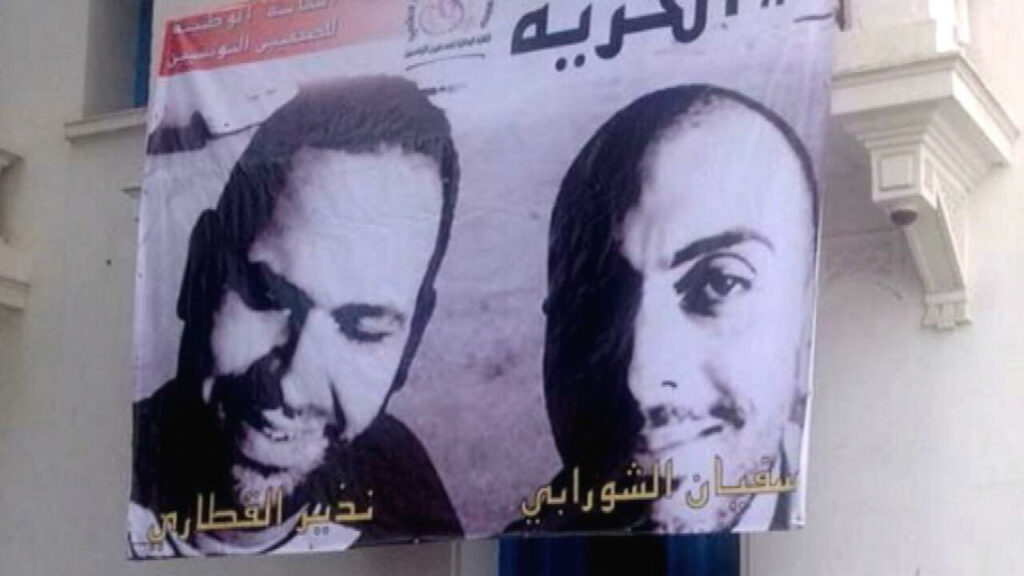
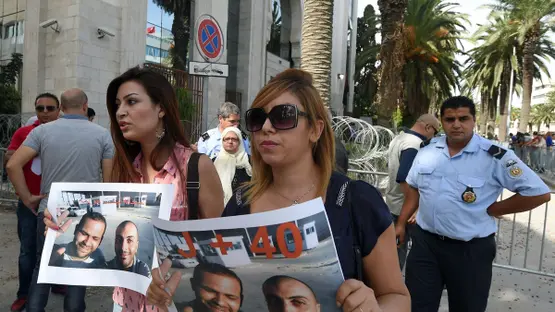
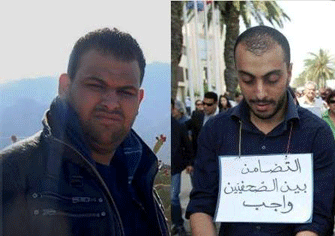
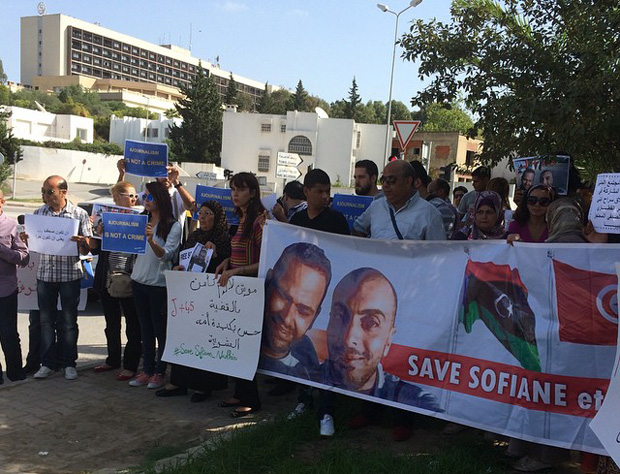
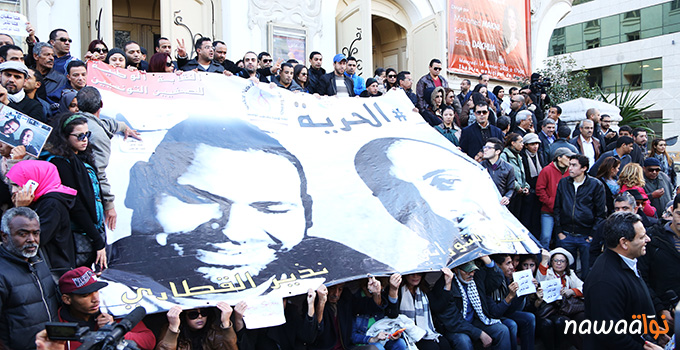
As uncertainty persisted, civil society organizations continued to demand answers. The National Syndicate of Tunisian Journalists organized solidarity actions, displayed the journalists’ portraits during demonstrations, and appealed to international institutions to help establish their fate.
International organizations, including Reporters Without Borders and Amnesty International, also drew attention to the case and the broader risks facing journalists in conflict zones. Their interventions helped maintain public attention on the disappearance and reinforced calls for credible investigations and accountability.
Yet sustained advocacy did not produce a definitive resolution. The case remained emblematic of the difficulties surrounding disappearances in conflict zones, where fragmented institutions, limited access to evidence, and competing claims can obstruct the search for truth.
Contradictory Statements and the Absence of Evidence
One of the most troubling aspects of the case was the inconsistency of statements attributed to Libyan officials and other actors. At different moments, reports suggested that suspects had been arrested or that confessions had established the journalists’ deaths. Other accounts challenged these claims or offered different versions of events.
Announcements concerning the alleged killing and burial of the journalists were particularly distressing for their families. Without independently verified evidence establishing their fate, however, such statements could not provide the certainty needed to end the search.
The contradictions created a painful cycle of hope and disappointment. Every new claim raised the possibility of an answer, but the lack of conclusive evidence left the families unable to establish what had happened to their loved ones.
Press Freedom After the Revolution
The disappearance of Chourabi and Ktari also raised difficult questions about the future of Tunisian journalism after the 2011 revolution. Freedom of expression had opened new possibilities for reporting, criticism, and public debate. Yet the risks facing journalists working beyond Tunisia’s borders exposed the limits of those gains.
What protection could a journalist expect when reporting from a conflict zone? What responsibility did the state have when a Tunisian journalist disappeared abroad? And how could accountability be pursued when the institutions responsible for investigating a case were themselves divided or unable to exercise effective control?
These questions extended beyond the fate of two individuals. They concerned the relationship between press freedom, state responsibility, and the safety of those who document political violence. The case also demonstrated the importance of independent journalism and civil society in keeping unresolved disappearances within public consciousness.
Keeping Their Names in Public Memory
The disappearance of Chourabi and Ktari did not disappear from public debate. The National Syndicate of Tunisian Journalists continued to organize commemorations and solidarity actions around the anniversary of their disappearance, displaying their portraits and renewing calls for answers.
These gatherings served as reminders that the case remained unresolved. They also prevented the journalists’ names from being reduced to a passing news story, keeping their families’ search and the wider questions surrounding their disappearance in public view.
Over time, Sofiane Chourabi and Nadhir Ktari became symbols of the dangers faced by journalists working in unstable environments. Their case came to represent both the possibilities opened by Tunisia’s post-revolutionary press and the vulnerabilities that persisted despite those changes.
2015: A Search Obstructed by Conflict
By early 2015, the search for Chourabi and Ktari had become a prolonged ordeal marked by uncertain reports and repeated disappointments. The expansion of extremist groups in parts of eastern Libya, alongside reports of kidnappings and summary executions, further complicated efforts to establish what had happened.
Investigating the disappearance required access to information and territory that no single authority could reliably guarantee. For Tunisia, the challenge was not simply to obtain information about two missing citizens, but to pursue answers across a border where political division and armed conflict severely restricted cooperation.
The passage of time made the search more difficult, but it did not resolve the central question. Without conclusive evidence, competing accounts remained just that: accounts, not established facts.
The disappearance of Sofiane Chourabi and Nadhir Ktari continues to underline a fundamental principle of press freedom: journalists must be able to pursue the truth without their own fate becoming an unanswered question. Until credible evidence establishes what happened to them, the responsibility to seek answers remains.
Families Searching Against All Odds
The families of Sofiane Chourabi and Nadhir Ktari refused to give up. Nadhir’s mother travelled to Tripoli, Benghazi, and Ajdabiya, meeting officials, intermediaries, and members of local armed groups in search of information about her son.
Her efforts were made more difficult by the security situation. Dangerous roads, political divisions, and unreliable accounts complicated every step of the search. Still, she continued to collect testimonies and follow leads, hoping that one might eventually reveal what had happened.
Meanwhile, Tunisian authorities sought to coordinate with Libyan officials and United Nations missions to exchange information. However, Libya’s political divisions and the influence of local armed groups severely limited these efforts. With rival authorities controlling different territories, identifying those responsible for the journalists’ disappearance proved extremely difficult.
Conflicting Testimonies and Renewed Uncertainty
Contradictory accounts continued to emerge over the following years. Some Libyan sources claimed that the journalists had been killed, while others suggested they might still be alive.
In 2016, a Libyan newspaper published the testimony of a former security official who reportedly claimed to have obtained confessions indicating that Chourabi and Ktari were alive in an undisclosed location. However, the account was not supported by independently verified evidence. It became another unconfirmed lead in a case already marked by conflicting statements.
Each new report raised the possibility of progress, but none established the journalists’ fate. For their families, the absence of reliable information meant that hope and uncertainty continued to coexist.
A Symbol of Journalism Under Threat
As the years passed, the disappearance became emblematic of the dangers faced by journalists working in conflict zones. International media organizations warned about the risks of abduction and violence in Libya, calling for stronger protection measures and better coordination when journalists went missing.
These discussions gave the case a wider significance. The disappearance of two Tunisian journalists became part of a broader debate about the responsibilities of governments, the protection of media professionals, and the difficulties of investigating crimes in territories affected by armed conflict.
Yet international attention did not produce a definitive answer. Chourabi and Ktari remained missing, and their families continued to seek information about their fate.
Keeping the Case in Public Memory
In the years that followed, the journalists’ families continued to pressure Tunisian authorities to pursue the investigation. Reports occasionally emerged from individuals claiming to have seen the two men in the custody of local armed groups. However, these testimonies were often difficult to verify and did not resolve the central questions surrounding their disappearance.
Between 2017 and 2018, the decline of the Islamic State’s territorial influence in eastern Libya appeared to offer new possibilities for investigation. Nevertheless, insecurity and the continued influence of armed groups restricted access to key locations. The political situation remained unstable, and the search continued without a conclusive outcome.
Throughout this period, the National Syndicate of Tunisian Journalists and other advocates helped keep the case in public view. Commemorations, demonstrations, and media coverage ensured that the journalists’ names were not lost amid the region’s continuing political crises.
Press Freedom and the Limits of Protection
The case also became a reference point in discussions about press freedom in Tunisia and across the Arab world. After the 2011 revolution, Tunisian journalists had gained greater space to investigate, criticize, and report on public affairs. The disappearance of Chourabi and Ktari exposed the vulnerabilities that remained when journalists worked in dangerous environments beyond their country’s borders.
Their case raised difficult questions about the responsibility of governments to protect their citizens abroad and the ability of international institutions to respond when journalists disappear in conflict zones.
It also highlighted the limits of relying on diplomatic statements and unverified testimonies. Without physical evidence or a comprehensive, independently verified account, claims about the journalists’ fate could not be treated as definitive.
International Advocacy and the Search for Justice
International organizations continued to draw attention to the disappearance as part of wider efforts to protect journalists and defend press freedom. The Committee to Protect Journalists and Reporters Without Borders have documented the risks faced by media professionals in conflict zones and called for accountability in cases involving missing or killed journalists.
The Chourabi and Ktari case illustrates the challenges of pursuing justice when investigations cross borders and the institutions involved have limited authority or access. Political fragmentation, security risks, and the difficulty of verifying information can leave families waiting for answers for years.
Meanwhile, civil society campaigns, university discussions, conferences, and digital media initiatives helped preserve public awareness of the case. These efforts served as reminders that the disappearance of journalists should not be forgotten simply because time has passed.
The Human Cost of an Unresolved Disappearance
Behind the political and diplomatic complexities are two families who have spent years searching for answers. Nadhir’s mother continued to pursue leads, meet officials, and speak publicly about her son’s disappearance. Sofiane’s family also followed developments and participated in efforts to keep the case alive.
Their persistence reflects the particular pain of not knowing what happened to a loved one. Without conclusive evidence, the families have been unable to move beyond uncertainty. Every new testimony offers a possible lead, while every unverified claim risks renewing the same cycle of hope and disappointment.
Their experience also underscores a fundamental right: families deserve to know the fate of relatives who have disappeared, and authorities have a responsibility to pursue credible investigations.
More Than a Decade Without Answers
More than ten years after Sofiane Chourabi and Nadhir Ktari disappeared in Libya, their fate remains unresolved. Changes in the region’s security landscape have occasionally raised hopes for renewed investigations, but political divisions and the lack of verifiable evidence have continued to obstruct progress.
Their disappearance has become more than an individual tragedy. It represents the risks journalists face when reporting from conflict zones, the difficulties of securing accountability across borders, and the limits of existing mechanisms for protecting media professionals.
The case also demonstrates the importance of public memory. Through the efforts of their families, journalists, and civil society organizations, the names of Chourabi and Ktari have remained part of Tunisia’s continuing conversation about press freedom and the right to know the truth.
Until credible evidence establishes what happened to them, the search for answers remains unfinished. Their disappearance is a reminder that protecting journalism means more than defending the freedom to publish. It also means working to ensure that those who pursue the truth are not abandoned when they disappear.