





In Memoriam: Tahar Haddad
Tahar Haddad was a Tunisian writer trained in Islamic law who became one of the most contested public intellectuals of the French Protectorate period because he treated social reform as a matter of rigorous argument rather than etiquette or gradual custom. Born in Tunis in 1899, he was educated at the Zitouna institution and completed his studies in 1920, acquiring the juristic vocabulary and methods that would later structure his interventions. That formation is essential for understanding his work: Haddad did not write as an external critic of religious reasoning but as someone who regarded interpretation as historically situated and therefore open to scrutiny, revision, and moral evaluation. His early adulthood coincided with an intensified struggle over colonial power and over the internal composition of Tunisian society, including disputes about political representation, education, labor, and the family. Within that environment he moved toward nationalist politics while also insisting that the “social question” was not secondary to anticolonial claims. His writings on labor and workers addressed the realities of exploitation and organization under colonial capitalism and treated the emergence of collective action as a central element of political life rather than an economic technicality. The significance of this orientation lies in how it widened the field of legitimate political speech: for Haddad, the dignity of workers and the regulation of work were not marginal topics to be postponed until after national liberation but immediate sites where justice and authority were tested.

In 1930 Taher Haddad published his most famous and most polarizing book, commonly known in English as Muslim Women in Law and Society, which examined women’s status through an argument that combined legal analysis with an account of social conditions. The work did not proceed by simply opposing religion to modernity. Instead it questioned the claim that prevailing practices were religiously inevitable, distinguishing between foundational principles and historically contingent juristic positions, and it treated education, economic dependence, and marriage practices as interlocking components of inequality. He argued that interpretive choices had been naturalized into social certainties and that this naturalization had ethical consequences for women’s agency and for the credibility of legal authority itself. The book’s method was therefore confrontational in a specific sense: it required readers to accept that inherited answers were not beyond debate and that moral responsibility included the responsibility to interpret. This stance triggered a major backlash. Religious authorities and influential public voices denounced Haddad, and accounts of his life consistently describe a campaign of discrediting that led to his marginalization and social isolation. The controversy mattered not only as an episode of reception but as a constraint on his ability to participate in public life, shaping his final years as a period marked by exclusion rather than institutional influence.
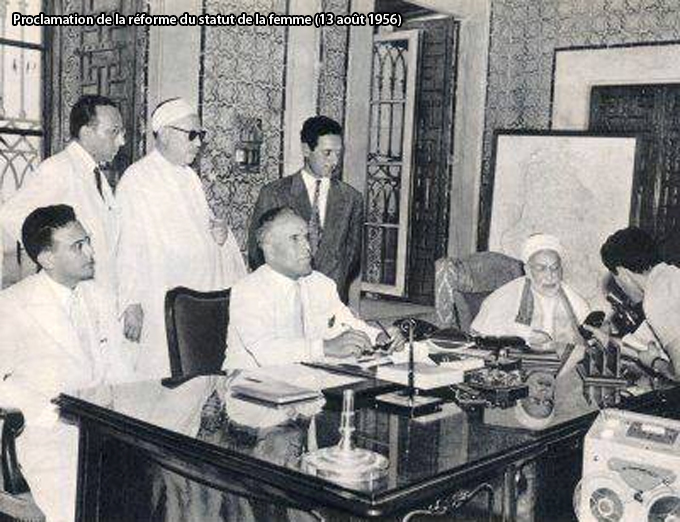
Taher Haddad died in 1935 at the age of thirty five, leaving a body of writing that was small in volume but durable in its afterlife. After independence, his name was increasingly rehabilitated in Tunisian public culture and scholarship, and his arguments were often revisited in relation to later debates about women’s legal status and the terms of reform. An academically cautious assessment avoids reducing subsequent legal changes to a single precursor, since reforms emerge from institutions, political struggles, and shifting social practices rather than from one author’s propositions. Even so, Haddad’s posthumous prominence is not accidental. His work provided a model of how to argue for social transformation without abandoning the language of law and ethics that structured public legitimacy in his society. He exemplifies a particular intellectual position within twentieth century Tunisia: a juristically trained reformist who linked anticolonial politics to labor and gender questions, who treated social life as a field where authority must justify itself, and who paid a personal cost for insisting that interpretation is a responsibility rather than a ritual.

Post a Comment